
Two types of patient ask us this most. Teenagers who’d rather not spend two years being “the one with braces” and adults (often in their thirties or forties) who’ve finally decided this is the year they sort out a smile they’ve been quietly unhappy with since school.
Neither group should choose based on which one looks better in photos. The honest starting point is what your teeth and bite are actually doing, because some cases genuinely only work one way. For everyone else, it comes down to lifestyle, discipline, and budget.
The difference between metal braces and clear aligners
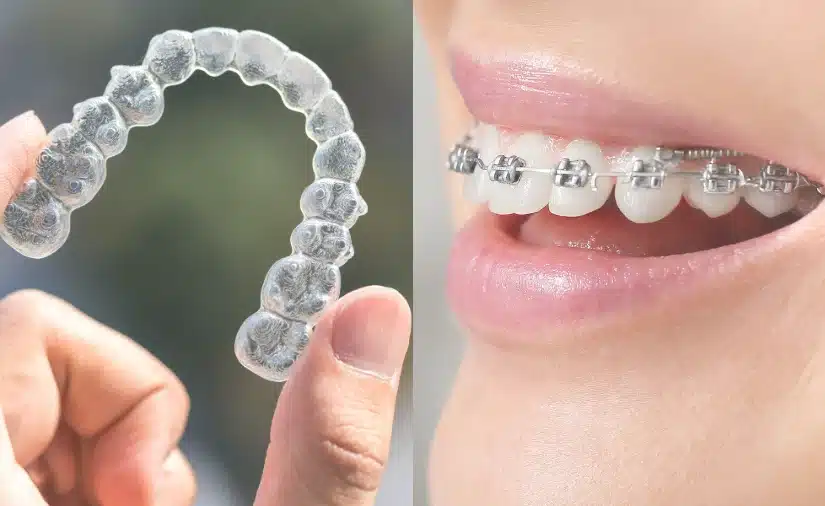
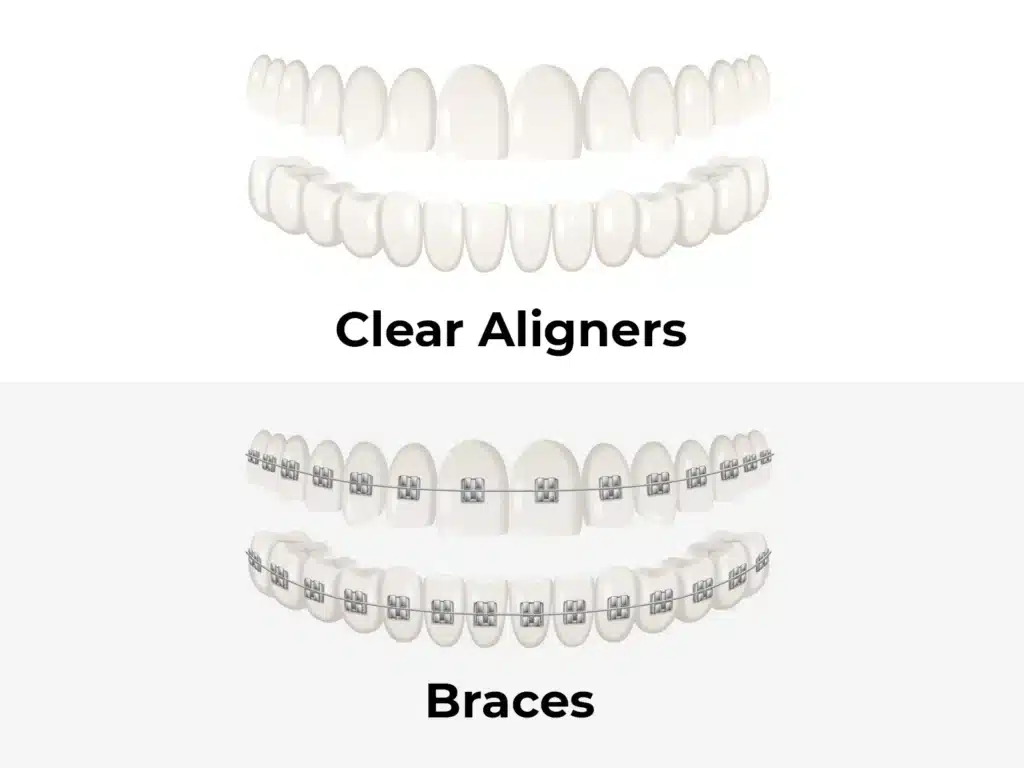
Braces move teeth using fixed brackets and wires, applying continuous, adjustable force for the whole course of treatment. Clear aligners do the same job through a sequence of removable trays, each one nudging teeth slightly further than the last before you swap to the next.
Both, done properly, get good results. The question worth asking isn’t which is “better”, it’s which one suits your particular teeth.
Traditional braces: less discreet but highly effective
Braces carry a reputation problem mostly built on nostalgia — most adults’ only memory of them is secondary school. Modern fixed braces are considerably more refined than that, and for a specific reason: nothing else gives an orthodontist quite the same continuous control over how a tooth moves, including rotation and tilt, not just left-right position.
That level of control is one reason fixed braces remain an important option for complex cases, particularly where significant tooth movement, severe crowding or more complicated bite correction is required. Clear aligners can treat an increasingly wide range of cases, but some situations require additional techniques or fixed appliances to achieve the most predictable result.
The cost of that reliability is daily inconvenience. Certain foods are off-limits (toffee, hard bread crusts, anything you’d bite into rather than cut), cleaning around brackets takes longer, and there’s usually a few days of tenderness after fitting and after each adjustment. Most patients stop noticing within a few weeks — but it’s a genuine adjustment period, not a footnote.
Treatment length varies enormously by case. Simple alignment can sometimes finish in a matter of months while comprehensive correction more commonly runs to 12–24 months.
Clear aligners: discreet, but only if you commit
Aligners work through a series of thin, custom-fitted trays, usually swapped every one to two weeks as your teeth gradually move. At Pine Dental we plan every case using digital scanning rather than the old-style impressions, using Invisalign and Angel Aligners.
The obvious appeal is that they’re close to invisible and you take them out to eat — no dietary restrictions, no different cleaning routine. For adults specifically weighing up whether treatment will be obvious in every meeting for the next year, this is often the deciding factor before the clinical side even comes into it.
But there’s a catch most marketing glosses over: aligners only work if you actually wear them, typically 20 to 22 hours a day. Take them out too often, lose one, or forget to put them back in after a meal out, and your teeth simply won’t move on schedule — which extends treatment or compromises the final result. It’s not a willpower failing so much as a mismatch between the treatment and how that particular person actually lives. If that sounds like you, it’s worth being honest about it at the consultation stage, not halfway through treatment.
Mild to moderate crowding and spacing generally respond very well to aligners. Severe crowding, significant rotations, or bite problems needing real jaw-position correction often need braces instead, or a combined approach — pushing an aligner system past what it’s suited for tends to disappoint.
Side by Side
| Clear aligners | Traditional braces | |
|---|---|---|
| Visibility | Almost invisible | Visible |
| Removable | Yes | No |
| Best suited to | Mild–moderate crowding & spacing | Complex crowding, rotations & bite correction |
| Cleaning | Normal brushing & flossing | Extra care around brackets & wires |
| Relies on | 20+ hours’ wear per day | Fixed in place |
| Treatment length | 6–18 months | 12–24 months |
| Cost | From £3,000 | From £3,000 |
| Retainer after | Yes | Yes |
What we look at during your smile consultation
We don’t ask you to pick a treatment off a leaflet. It starts with a proper assessment — digital scans of your teeth and bite, a look at your gum health, and a conversation about what’s actually driving the decision for you, whether that’s cost, visibility, timeframe, or the clinical need itself. From there we can usually show you a digital simulation of how your teeth are expected to move, which tends to make an abstract choice feel a lot more concrete.
Retention matters just as much as active treatment, whichever route you take. According to the British Orthodontic Society, nearly all patients need to wear retainers after treatment finishes, because teeth naturally drift back toward their original position over time — a process called relapse. How consistently you wear your retainer afterwards is a genuine part of whether the result lasts, not an optional extra.
Which Is Better: Clear Aligners or Braces?
Ultimately, neither treatment is universally better. Clear aligners can be an excellent option for suitable cases where discretion and removability are important. Braces may be preferable when more complex tooth movements or bite correction are required. The right choice depends on your individual teeth and treatment goals.
Frequently Asked Questions
Are clear aligners as effective as braces?
For mild to moderate crowding and spacing, results are broadly comparable. For complex rotations or significant bite correction, braces generally offer more predictable control.
Are clear aligners better than braces?
Not automatically — each suits different cases. Aligners are more discreet and removable; braces give more consistent control for complex movements. Suitability depends on your teeth, not preference alone.
How long does treatment take?
Clear aligners typically run 6–18 months for straightforward cases. Traditional braces more commonly take 12–24 months for comprehensive treatment. Your consultation will give a realistic estimate for your specific case.
Which is cheaper, braces or clear aligners?
Cost depends on complexity and length of treatment rather than the appliance type alone — it’s worth comparing full treatment-plan costs rather than assuming one is always cheaper. We’ll provide a clear quote after assessment.
Can adults get braces or clear aligners?
Yes. A growing proportion of our orthodontic patients are adults, and age itself isn’t a barrier provided your teeth and gums are healthy enough for treatment.
Book a consultation in Sutton
We see orthodontic patients from Sutton, Cheam, Carshalton, Belmont and Wallington — teenagers starting their first course of treatment, and adults finally getting round to it decades later than they’d planned. If you’re not sure which option fits your case, that uncertainty is exactly what the consultation is for.
Pine Dental & Aesthetics is located in Belmont, Sutton, directly next to Belmont Train Station and bus stops. We also have plenty of free parking spaces. Call us on 020 3535 6260 or email hello@pinedental.co.uk to speak to a member of our team to start your new smile journey.