
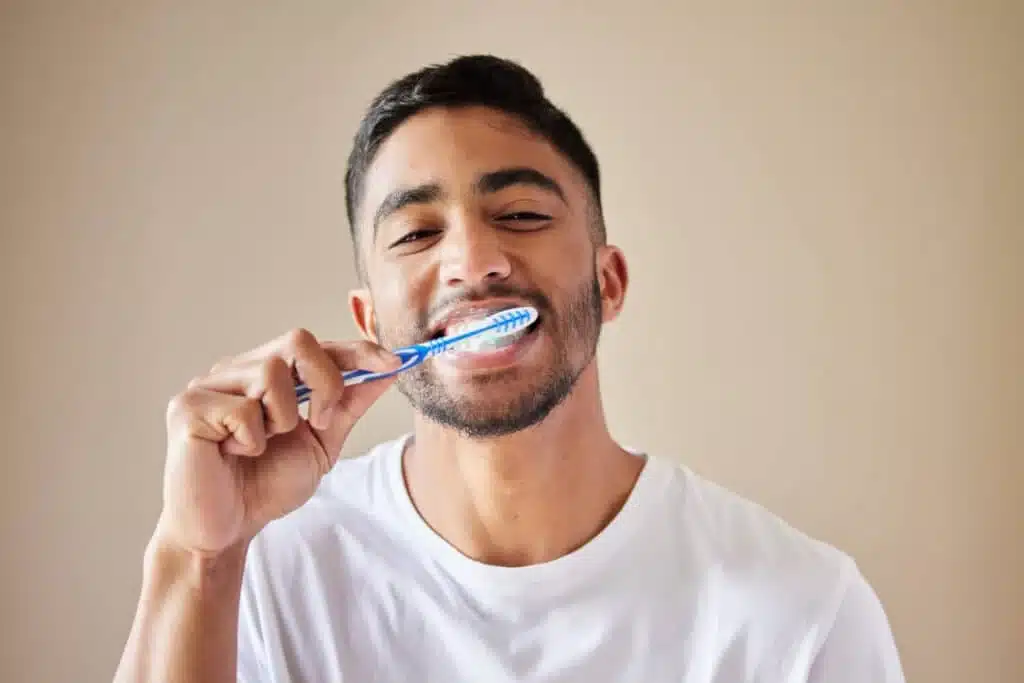
Yes. Brushing too hard can damage both your teeth and gums. Applying excessive pressure when brushing may wear away enamel, cause gum recession, increase tooth sensitivity and leave your teeth more vulnerable to decay. Fortunately, using the correct brushing technique and a soft-bristled toothbrush can prevent these problems.
Is Your Toothbrush Doing More Harm Than Good?
We regularly see patients who are convinced they have gum disease. Sore gums, a bit of bleeding when they brush. But this doesn’t necessarily mean one has gum disease. It can be caused by your toothbrush technique, or more specifically, how hard you are pressing.
This is one of the most common things we see at Pine Dental in Sutton, and it catches people out because it feels counterintuitive. Surely brushing harder gets your teeth cleaner? In practice, the opposite tends to happen: heavy-handed brushing wears down enamel and pushes gum tissue back, and neither of those grow back on their own.
Can you actually brush too hard?
Yes, and it’s more common than most patients expect. Plaque is soft. It doesn’t need much force to shift it — a gentle, methodical clean does the job far better than scrubbing. Pressing hard with a firm-bristled brush (or an electric brush without a pressure sensor) doesn’t get your teeth any cleaner. It just grinds away at enamel and irritates the gumline, which over time can lead to sensitivity, visible recession, and in more advanced cases, exposed roots that need proper dental treatment to put right.

Signs you are brushing your teeth too hard
Some of these you’ll notice yourself. Others tend to show up during a routine check-up before the patient’s even mentioned anything.
Sensitive teeth: Once enamel thins, the layer underneath (dentine) is more exposed to temperature and sugar. That twinge on your morning coffee is often the first clue.
Receding gums: If your teeth seem to be “getting longer,” that’s usually gum recession, not tooth growth — the gum has receded and exposed more of the root.
Bleeding gums: Bleeding gums get blamed on gingivitis a lot, and sometimes that’s right. But irritated, over-brushed gum tissue bleeds too, especially near the gumline.
Yellowing near the gumline: Enamel is white; dentine underneath is more yellow. As enamel wears thin, that colour starts to show through.
Grooves at the gumline: Run your tongue along your teeth near the gums — if you feel small dips or ridges, that’s toothbrush abrasion, and it’s usually a sign the pressure (or the brushing angle) needs adjusting.
Overused toothbrush: Bristles should wear evenly and gradually over about three months. If yours are splayed out sideways after three or four weeks, that’s a pressure problem, not a bad toothbrush.
Soreness after brushing: Your gums shouldn’t hurt once you’ve finished. If they do, something in your technique needs a rethink.
Left unchecked, this pattern can snowball — worn enamel is more vulnerable to decay, not less, and advanced gum recession can eventually affect how stable the tooth itself is. None of that is inevitable, though, and it’s very treatable when caught early.
Not brushing hard enough causes problems too
It’s worth saying: this isn’t an argument for brushing gently and rarely. Underbrushing lets plaque sit on the teeth and along the gumline, where it hardens into tartar and tartar can only be removed by a hygienist, not a toothbrush. Skipping the job isn’t the fix, doing it properly is.
The sweet spot is two minutes, twice a day, with a light touch and good technique, not more pressure, just better coverage.

What good brushing technique actually looks like
- Two minutes, morning and night. Most people brush for closer to 45 seconds without realising it — try timing yourself once.
- Soft bristles. Always. If the packet says “medium” or “firm,” it’s not for you.
- Angle the brush at roughly 45 degrees toward the gumline, not straight into it.
- Small circular motions rather than side-to-side scrubbing — think “massage,” not “scour.”
- Cover every surface: outer, inner, and the chewing surfaces at the back, which get missed constantly.
- Brush your tongue gently while you’re at it — it makes a genuine difference to breath.
- Floss or use interdental brushes daily. Brushing alone cannot effectively clean the spaces between your teeth, which is why daily flossing or interdental brushes are recommended.
- Spit, don’t rinse. Rinsing with water washes away the fluoride that’s still working after you’ve finished.
- Visiting the dental hygienist for a deep clean of your teeth and gums.
- Visiting the dentist every 6 months for your regular dental check-up.
Is an electric toothbrush better than a manual toothbrush?
Both clean effectively if you’re using them properly. Where electric brushes tend to win is consistency, most people naturally brush more evenly with one, and a lot of modern electric brushes have a pressure sensor that lights up or pulses when you’re pushing too hard. If heavy-handed brushing is a habit you’re trying to break, that feedback alone can be worth the upgrade.
Whichever you use, change the head every three months, or sooner if the bristles are already looking tired.
Can the damage be undone?
Depends what’s happened and how far it’s gone:
- Sensitivity often responds well to fluoride treatment or a desensitising toothpaste.
- Gum recession ranges from something we can manage and monitor, through to gum grafting in more advanced cases.
- Worn enamel can usually be restored with composite bonding, veneers, or crowns depending on the extent.
- Cavities from enamel loss are generally straightforward to treat with a filling if caught before they progress further.
The theme running through all of these: earlier is easier. A lot of this damage builds quietly over months or years, so by the time it’s obvious, it’s often already fairly advanced.
When it's worth coming in
If you’re noticing bleeding, sensitivity, or gums that look different to how they used to, don’t wait for your next routine check-up to mention it. We can usually tell fairly quickly whether it’s technique-related or something else, and either way, the earlier we look, the more options there are.
If you’re experiencing tooth sensitivity, bleeding gums or receding gums, arranging an examination sooner rather than later can help prevent further damage. Our team at Pine Dental in Sutton can identify whether your symptoms are caused by brushing technique, gum disease or another underlying issue and recommend the most appropriate treatment.
At Pine Dental in Sutton, we see this regularly across patients from Sutton itself as well as Cheam, Carshalton, Belmont, and Wallington. If you’re local and something doesn’t feel right, get in touch.
Frequently Asked Questions
Can brushing too hard actually damage tooth enamel?
Yes. Excess pressure gradually wears away enamel, and because enamel doesn’t regenerate, that wear is permanent unless treated with bonding, veneers, or a similar restoration.
Does brushing too hard cause receding gums?
It’s one of several contributing factors, alongside genetics and gum disease. Aggressive brushing physically pushes gum tissue away from the tooth over time.
How can I tell if I'm brushing too hard?
The clearest signs are bleeding gums, sensitivity, visible recession, and a toothbrush that frays or splays within a few weeks of use.
How often should I see a dentist about this?
If you’re noticing any of the signs above, book sooner rather than waiting for your routine check-up. Otherwise, a standard six-monthly review is generally enough to catch early changes.
Book a consultation
Pine Dental & Aesthetics is located in Belmont, Sutton, directly next to Belmont Train Station and bus stops. We also have plenty of free parking spaces. Call us on 020 3535 6260 or email hello@pinedental.co.uk to speak to a member of our team to start your new smile journey.